Tel : (+33) 4 94 63 18 08
9am - 6pm from Monday to Sunday


All products Salvador Dali • Products of the topic Art Prints
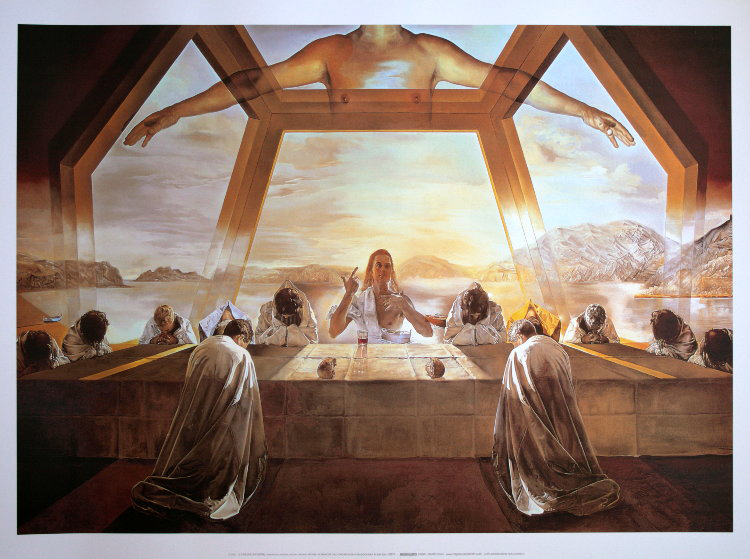
Art print Dali - The Last Supper - 80 x 60 cm
REF : SD-OFF-22
Unavailable
Only 1 in stock
In stock
39,00 €
Reproduction in Fine Art print on a heavyweight satin finished Art paper .
Dimensions : 80 x 60 cm (31.5" x 23.6")
Discover the artist's categories




Salvador Dali
Additional cultural and artistic information about the artist
* * *
Main works
The Soft Watches, The Persistence of Memory, The Christ of Saint John of the Cross
Artistic movements
Surrealism
Inspiration, influence
Impressionism until 1919, cubism afterwards. Furthermore, psychoanalysis, which was a major discovery in Dali's life, also left its mark on his painting.
His contemporaries
Joan Miró and, of course, Pablo Picasso, whom Salvador Dalí admired and called a genius (on a par with da Vinci or Velázquez), as well as writers (Paul Éluard, André Breton or García Lorca) and the great Surrealists he accompanied — with whom he also fell out: Buñuel, Magritte or Tanguy.
To keep in mind
Beyond the painter, the persona of Salvador Dalí cultivated an image of a "super-artist, offbeat and bizarre"... He liked people to talk about him, whether for better or for worse...
To go further
"Un Chien Andalou", co-written in 1929 with Buñuel, is a short film that laid the foundations of visual surrealism, as well as of the bizarre and narcissism as forms of art.
Biography of Salvador Dali

Salvador Dali
Salvador Dali was born in Figueras on May 11, 1904.
At the age of 17, he entered the School of Fine Arts in Madrid, from which he was definitively expelled in 1926 for anarchic conduct. During these five years, he formed strong friendships with Federico Garcia Lorca and Luis Bunuel (for whom he wrote the screenplay for "Un Chien Andalou" in the late 1920s).
His early exhibitions, while he was still wavering between cubism and surrealism (it was Miro, along with his admiration for Arp and Tanguy, that led him in this direction), drew attention to him. The strength of his lines, the precision of his painting quickly earned him recognition in major galleries in Barcelona, as well as those in Paris, London, or New York.
During the summer of 1929, he met Gala Eluard (wife of Paul Eluard), who would never leave him again, becoming not only his companion but also his muse.
The Spanish Civil War, the assassination of Garcia Lorca in Granada, and the outbreak of World War II, along with some attacks from other surrealists accusing his work of "glorifying Hitlerian fascism," prompted him to leave Franco's Spain for eight years in favor of the United States.
In 1952, he began work on the wood engravings for Dante's "Divine Comedy," which remains one of his most famous works, before following up a few years later with "The Apocalypse of Saint John."
Celebrated and honored during his lifetime (notably by the opening of a museum dedicated to him in his hometown), he enjoyed playing with the media in the last years of his life.
He passed away on January 21, 1989, joining Gala who had passed away 7 years earlier.
(c) Natacha PELLETIER for PASSION ESTAMPES